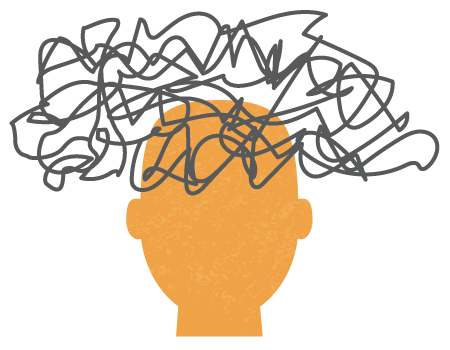
We live in a world nowadays where anxiety runs rampant. Whether or not that is through a clinical diagnosis or not, there seems to be at least an undertone of anxiousness in today’s society. According to the World Economic Forum, an estimated 275 million people experience anxiety disorders. Now, just think about just college students. College is a time when individuals are tasked with becoming master jugglers, trying to simultaneously keep rigorous course loads, new friendships, romantic interests, intense academic tracks, and vocational readiness all off the ground. College students’ brains are filled to the brim with effortful thoughts surrounding all these different aspects of college, not even to mention any personal interests or concerns. The National College Health Assessment in 2018 stated that “63% of college students felt overwhelming anxiety in the last year” (LeBlanc & Marques). These statistics are not even considering how climate could be playing on these levels of anxiety. In a global survey by Hickman et al., it was found that in the United States alone, 26% of citizens say that their worries about climate change impact their functioning as humans. See how prevalent this issue is? Anxiety is a real issue that is taking control of the minds of many individuals. The world we are living in today is plagued with anxiety, so the question to consider is how can we be a non-anxious presence in an anxious world.
Now I am not at all saying that it is “bad” or “wrong” to feel anxious. Anxiety is real and it is valid to feel this way. What I am suggesting in this blog post is that perhaps there can be a way to not let your anxious thoughts overwhelm and consume your everyday life. In A Field Guide to Climate Anxiety, Sarah Jaquette Ray highlights eco-nihilism. There is a growing belief among individuals concerned with the current climate crisis that the world would be better off without humans on it since we are inherently bad for the planet. Ray argues against this notion of eco-nihilism, stating that “we are all worthy of living on earth, and we do not need to spend our lives repenting the sin of being human” (40). I appreciate Ray’s assurance to us that we do not need to cast immense blame on ourselves for the state of the world. We are meant to be on this earth despite how threatening we can be to it. However, regardless of this, there still seems to be a hole. One can read this and feel less poorly about themselves, but there is still the issue at hand. The climate is still problematic and my anxiety about it is still high. Ray’s assurance against eco-nihilism sounds nice while I read it now, but fast forward a few weeks or months, or years, and I very well may lose sight of that assurance.
This leads me to my point. The way that I feel like one can be a non-anxious presence in an anxious world is by surrendering your fears to a higher power. As humans, we like to believe that we have the power to create substantial change. We may think the agency to turn the world around is solely in our hands. But I am not so sure of that. I believe that it is our job as humans to be stewards of the earth. I take the posture that the earth is a gift given to us by a God who loves us. Therefore, it is our responsibility to do our part in caring for the planet. But, I take rest in knowing that there is a higher power that has more than enough ability to restore the planet. Sarah Jaquette Ray alludes to this point by mentioning our locus of control. She encourages her readers to respond to what is within their sphere of influence. Practically, we cannot enact governmental policy for every major world power, but we could instead live cautiously ourselves to preserve power, pollute less and be mindful of our carbon footprint (65). At the end of the day, if we do those things, we alone are not going to change the world. We would need millions of people to buy into the same environmental mindset to see change. But even then, the fate of the world is out of our hands. Without the comfort of believing in a higher power governing the world and feeling like we as small humans are the ones responsible for fixing this giant earth, I feel like falling into a personal state of existential crisis would be inevitable.
Within her book, Ray highlights the importance of emotional intelligence. As climate advocates, we must be attuned to, but also regulatory our emotions. Ray suggests that we can use our emotions to influence our reasoning and thinking, “closely observing our emotions makes us behave more rationally” (34). This concept of emotional intelligence is a “radical concept” in western culture because feeling often falls second to reason. The climate movement needs emotional intelligence because this field is a lot of work to handle. Feelings of anger and anxiety and hope and longing are all valid emotions. We need to have an emotional engagement to get started in our work, but so many people struggle to manage their emotions which can lead to burnout. I want to note that the concept of entrusting your faith to a God or a higher power also seems to be a radical concept. But, I believe that taking a posture of dependency on an over-ruling God is a form of emotional intelligence.
One reason this is a form of emotional intelligence is that it addresses the concern of instrumentalism. Ray states that our efforts will never be enough for us if all we look for is the direct change we make (63). It is unreasonable to believe we can make a planet-wide change in climate by just our efforts. It goes back to living within our locus of control. Trusting in a supreme power helps define our sphere of influence in the sense that we do not have to act like God ourselves. One valid argument against this idea is that someone may not want to act as if they believe in something just to give them comfort. I respect this argument and in no way do I want the message of this post to give off an evangelist attitude. But my response would be that life has always been temporary. Way before climate anxiety reached the level it is at today, human life has always had an expiration date. So with that being said, what then is the point of any of this? Why care about the earth at all? We can move forward in being stewards of the earth knowing that our life is only temporary. But I ask you to consider what it personally feels like to take the burden off your back and place it on a higher power. Additionally, there have always been difficult problems happening in the world. Humans have gone into existential crisis during World War II, COVID-19, and countless other health or worldly scares. Being emotionally intelligent means that you are not worrying about the future more than you are worrying about today. We can go about the climate movement with a humble mindset by doing our part in it, not thinking that we solely are responsible for ending this state of anxiety for the world. Ray mentions how we as humans love to be in control. We are “less likely to be afraid of driving (because we feel in control behind the wheel) than flying (because we surrender control to a pilot), even though driving is statistically more dangerous” (82). We live in a society that encourages us to take control of all we can. Take control of your job, your finances, your family, and your relationships. But some things are not in our control. We are not in control of whether or not it is going to rain. We are not in control of the entirety of climate change. But, what if there is someone greater than us who is in control of it all?
Sources:
Flemming, S. (2019, January 14). This is the world’s biggest mental health problem – and you might not have heard of it. World Economic Forum. https://www.weforum.org/agenda/2019/01/this-is-the-worlds-biggest-mental-health-problem/
Hickman, C., Marks, E., Pihkala, P., Clayton, S., Lewandowski, R. E., Mayall, E. E., Wray, B., Mellor, C., & Van Susteren, L. (2021). Climate anxiety in children and young people and their beliefs about government responses to climate change: A global survey. The Lancet Planetary Health, 5(12), e863-e873. https://doi.org/10.1016/s2542-5196(21)00278-3
LeBlanc, N., & Marques, L. (2019, August 27). Anxiety in college: What we know and how to cope. Harvard Health. https://www.health.harvard.edu/blog/anxiety-in-college-what-we-know-and-how-to-cope-2019052816729
Ray, S. J. (2020). A Field guide to climate anxiety: How to keep your cool on a warming planet.
Shared by: Anonymous
Image Credit: https://shine365.marshfieldclinic.org/wellness/feeling-anxious-worried-or-panicky/