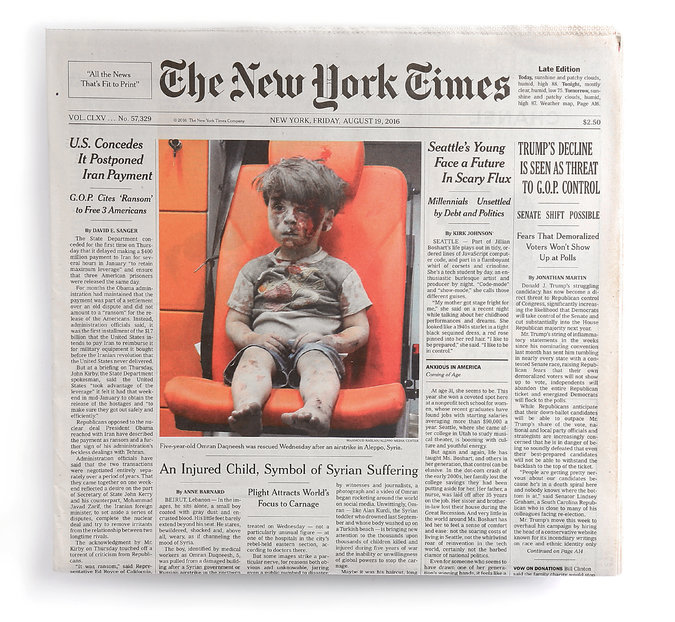
This picture of a child named Omar Daqneesh was taken in 2016 and was on the front page of many international newspapers after the bombing of Aleppo in August 2016. The picture won an award for most “defining image” of 2016 by the Getty and Sunday Times. The still shot picture of Daqneesh during his medical treatment provoked public eyes and hearts to take action against perpetrators who murder and destroy innocent lives. Through a momentary emotional series of shock, confusion, anger, and compassion, the picture of Daqneesh is reduced to its preferred meaning– an innocent child who has been traumatized and injured by the inescapable terrors of the Assad regime in the Middle East, and we must do all that we can to stop the impending threat and horrors the regime poses to our society.
As we look at the picture closer, we soon realize that Daqneesh does not look “foreign” on this picture. His floppy haircut and cartoon t-shirt connects him to the young boys we see at home– a young son, a brother, or a neighbor. Daqneesh becomes a canvas on which we paint our own emotional narratives, where philanthropists and benevolent souls are given the agency at the expense of victims, which secures a problematic hierarchy in our society. Not only does the picture and headline secure a strong appeal to our pathos, but it dominates our ethos by making it uncomfortable to critic against the dominant-hegemonic position. To say anything or doubt the credibility of the message would be disrespectful to Daqneesh and other innocent victims of war. Moreover, it would be emotionally distant of us to challenge the evident meaning it poses, after all, who would dare be against charity work? As consumers of media outlets, we have an ethical duty to analyze what compels us to take action. The picture of Daqneesh is only one example of how we let our emotions subjugate us to the preferred narrative of the few, instead of penetrating through the rhetorical maneuvers of self-proclaimed intellectual elites, and exposing the masquerade of propaganda as “the truth.”
The most vulnerable, yet most powerful target is our emotions, and many journalists and politicians are aware of how to access our sacred goldmine. As citizens in a democratic society, we feel obligated with our emotions to serve the greater good. What is the safest course of action for the majority? How do we protect the minority and marginalized? What does the majority favor? Although asking well intended questions for the benefit of our society is dutiful, allowing ourselves to become passive citizens and adhering to the select few in power like a herd of sheep following a shepherd, makes us vulnerable by possibly neglecting the necessary approaches to a problem. Daqneesh is silenced in the picture because of the narrative many of us have blindly covered him in like the ashes on his skin. Our angry emotions triggered by a picture of a helpless boy compelled us to take action before analysing what Daqneesh truly needs. As Rober C. Solomon stated in his book, “True to Our Feelings,” anger is a judgment that one has been wronged. It is a “continuous structure of one’s life.” Note, “one’s life.” With our anger, we reflect the misfortunates, anxiety, and shortcomings of our lives to an object. In this case, it is Daqneesh, but it is not always Daqneesh on the front page of a newspaper. We objectify our angry emotions on the news we read or hear that brings to light our anger and frustrations in the world, and that is how we subjugate ourselves to the helplessness of these destructive emotions.
There is no problem in feeling pity and outraged to provocative news and we must not deny those emotions. Emotions are a part of being human, but we must also train ourselves to be aware of the objects of our emotions. Many news sources catch readers’ attention by invoking a feeling of fear by providing an object to be fearful of. As Solomon stated,
“In such cases, fear seems to lack any particular object. Or rather, it seems to take everything as its objects. In such cases, we might say that fear is more like a mood, where moods, like some mysterious emotions, seem to be without an object, or in any case, without a specific object. Thus, Heidegger says that through the mood of angst, we tune in the reality of our lives in the world.”
By feeling fearful, angry, and acting upon those emotions without realizing the full context of the object of our fears, we are prone to act exactly what propagandists are asking from us– to be in dominant-hegemonic position, decoding and accepting the preferred meaning of news outlets because it simply accords with our own political values (Lisle). Being in such a position also creates a divide between those in need of help and those who are capable of helping. The media creates an illusion of “oneness” or “equality” through common misfortunes, but in reality, the appeal to our emotions creates a structural hierarchy and inequality that we unknowingly ignore. By allowing ourselves to act upon our fears and anger, we unconsciously participate in an illusion that we are helping the victims we see on the news, when in fact, we are allowing ourselves to participate in a social hierarchy of the oppressed and privileged where all political agency is focused on the viewer instead of the subject.
Denying our emotions would not solve the problem and I am no proponent of such. What we may need to do in order to truly make lasting changes is to begin analysing the world as we see it from within– through our emotions and our being-in-the-world. We cannot act outrageously and take course of action towards the first sign we see, because sometimes, the most available and convenient mode of action is one that would trap us further. For example, many pro-Assad reviewers argued that the bombing in Aleppo was staged by the anti-Assad party. If this was the case, to act accordingly in which the depiction of the image compelled us to do such as to rally against the Assad party, we would have unknowingly supported a regime that caused Daqneesh’s pain and trauma. This is just one of many examples of how the media could manipulate our emotions if we are not cognizant of our emotions. To truly make a consciously passionate change, we must not deny our emotions as emotionally driven causes such as charitable donations and aid do make a difference to plenty of lives, but we must also navigate how our emotions can be effectively used in intelligible discourse such as debates and discussions in which we are then fully capable of taking action.
Citation:
“How Do We Find Out What’s Going On.” Global Politics: a New Introduction, by Debbie Liesle and Maja Zehfuss, Routledge, 2019, pp. 145–161.
Solomon, Robert C. True to Our Feelings What Our Emotions Are Really Telling Us. Oxford University Press, 2008.
Shared by: UB
Image Credit: https://static01.nyt.com/images/2016/08/19/insider/19insider-warphotos/19insider-warphotos-master675.jpg
