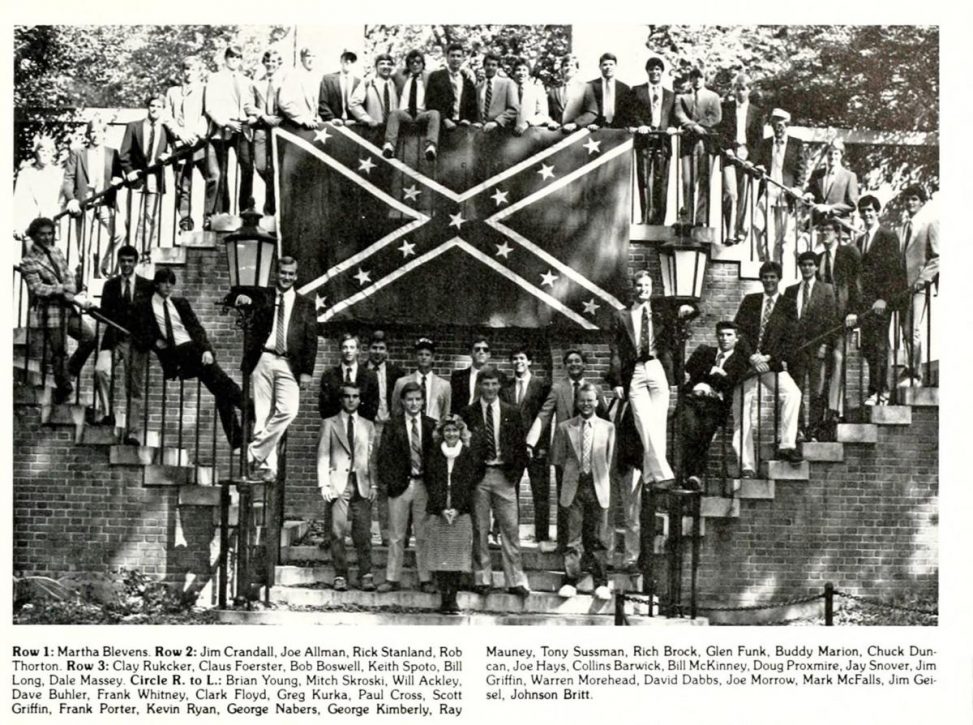
If you were to simply google Wake Forest, or something of that sort, all of these pages about the admissions process, how beautiful and diverse the campus is, how expensive it is, its national rankings, notable alumni, and the like would appear. What you might never find, unless you are a part of campus life somehow, is the nasty stain of racism and the silenced voices of the victims. Why do we not hear about these instances and steps being taken to create and foster a more inclusive and safe environment? One simple word will suffice as an answer: emotions.
Emotions can be looked at through two different lenses: cognitively and non-cognitively. Cognitivists view emotions as perceptual and cognitive. Non-cognitivists view emotions and feelings as behaviors/action tendencies. For the sake of this blog, I am exploring the cognitivist view of emotions and how in particular anger and shame are seen. Then with this view in place, I will offer a reason as to why anger is not as successful an emotion as we believe it to be. Robert Solomon, author of True to Our Feelings: What Our Emotions are Really Telling Us is a cognitivist. Being a cognitivist means that emotions have an “aboutness” to them. “… the essential fact [is] that anger is always about something.” (Solomon 19). An emotion is not merely just a physiological disturbance or feeling, nor is it just in someone’s mind. It is about something in the world.
Being a minority student on Wake’s campus has to be tough, especially when the former head Dean of Admissions, Martha Allman, was discovered posing in front of a Confederate flag with the fraternity Kappa Alpha in the 1982 yearbook (Drabble). If you are a minority student, how do you reconcile with the fact that the lady who played a vital role in your acceptance into this university is the same lady who has posed in front of a Confederate flag? The easy answer: anger, which (hopefully) fuels shame.
To Solomon, anger is a judgment that one has been wronged or offended (Solomon 18). For these students on campus, their anger is the judgment that they have been wronged by having someone in a position of power who has expressed racism and never confronted their past. From the time the photo was published to when the photo was discovered, Allman had carried around this problem for 37 years. This warrants the question of whether or not she felt ashamed about this poor decision. Another easy answer: not particularly.
There is no way that Allman felt guilt, although she felt some shame from this decision. Shame is a social emotion and it involves the sense of failing those around you. Solomon says that shame is also the sense that you have violated social norms and ultimately letting people down (Solomon 95). It took students discovering the offensive picture for Allman to publicly denounce her past actions. Although Allman admitted that she was ashamed, this recognition leads her to still view herself as part of society and is owning up to her mistakes (Solomon 96).
So if Allman owns up to her mistakes and admits that she is ashamed, then why are minority students still angry? Well, we can say that Allman could not have completely felt shame from her decision because she left her fate in the hands of President Hatch, who accepted her apology and forgave her. She did not wrong the president, but rather all past, present, and future minority students of Wake Forest. Students were outraged that she was not forced to resign like they believed she should have done. Instead, she was given a new position as Senior Assistant Provost and Dean of University Integration (Drabble). This is unfortunately not the only instance in which Wake has let minority students down.
In 2014, Kappa Alpha, the same fraternity in which Allman posed with, had a party shut down because their theme was “dress like a black person”. More recently in January 2018, a Snapchat video was released of a white freshman resident calling her black Resident Adviser the “n-word”. The name of the student and the cause of this behavior was never released. All that was said was that this particular student was no longer enrolled at the university. Yet, even more recently in September 2019, the Office of Diversity and Inclusion and the Intercultural Center, plus other departments, received emails that were intentionally inflammatory and threatening. Anger, according to Solomon is supposed to be a way for those who have been wronged to pull themselves up from a “one down” position to a “one up” position. That is the structure of anger (Solomon 24).
While the notion of anger being used to elevate oneself sounds plausible, minority students on Wake’s campus are an example of how this supposed cognitive structure of anger fails. The idea of using anger to pull oneself from a “one down” position to a “one up” position seems simple enough. If you are in a position where you cannot make changes to social injustices then becoming angry is a great way to let your voice be heard. Anger is a resource all have access to, as it is, according to cognitivists, a basic and innate emotion (Solomon 14). Yet, with this emotion being universal and seen as an option to be heard, then how come minority students are getting nowhere?
Anger is an easy emotion to become addicted to because of the challenges it presents, the rush of endorphins, the physiological response, and the response of others (Solomon 21). The response of others would lead to one who is angry being heard and the problem gaining the attention needed to change it. Solomon could respond to the problem of minority students not receiving the needed attention by claiming that they could be angry all the time and no one is going to take you seriously. These minority students could be addicted to anger because it allows them to seek out the injustices of their campus. This emotion of anger should still be getting minority students somewhere. So do we throw in the towel and call it quits on this problem? Not quite yet.
A last resort of why anger is not benefitting the minority students is Aristotle’s idea of righteous anger. Righteous anger is anger that is directed at the right person, at the right time, and to the right degree (Solomon 26). It could be possible that the minority students are not angry at the right person, not angry at the appropriate time, and not angry enough. If these students are not directing their anger in the right way, then their anger, according to Aristotle, is getting them nowhere. Yet, it is still better to attempt to direct your anger in appropriate ways, so as to not look like a fool (Solomon 26).
Minority students at Wake are justified to be angry and generate shame in those who have transgressed them. The lack of acknowledgment of this basic and primitive emotion in minority students is disgusting. While I cannot say for sure that the fact that they do not receive attention is because of their racial status, I cannot say for a fact that it is because it is not righteous or inducing enough shame. All I can say is that anger is driving minority students to search for answers and induce shame in those who have done wrong. Anger is not a way for minority students to position themselves “one up”.
References
Drabble, Jenny. “Associate Dean of Admissions Pictured in Separate Confederate Flag Photo after Wake Forest Dean of Admissions Issues Own Apology.” Winston Salem Journal, 22 Feb. 2019.
Solomon, Robert C. True to Our Feelings: What Our Emotions Are Really Telling Us. Oxford University Press, 2008.
Shared by: Madison
Image Credit: https://www.journalnow.com/news/local/associate-dean-of-admissions-pictured-in-separate-confederate-flag-photo/article_52466c8a-08ac-51df-9a2e-ec8fc8c74c60.html