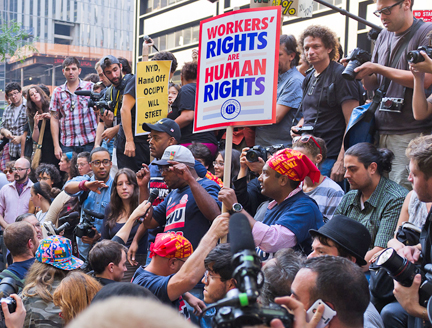
Climate Change, Inflation, Declining Union Membership, Corporate Lobbyists controlling Congress, and increasing income inequality. The America that our parents and grandparents knew, the America with a booming economy, jobs for everyone, Unions making sure that every worker gets what they have earned, and a government that is only getting better and that cares about us, is dying and we are witnessing it taking its last breaths right now. Yet, we are not in the streets fighting to take back the future that we were promised. We are not getting angry and fighting for the future that, by right, belongs to us. Let’s get mad. Let’s do something about it.
As Myisha Cherry says, “[w]e rob others of expressive resources when we disenfranchise them, block them from demonstrating, wave guns at them while they peacefully protest, dictate them access to media and cultural expressions, and more” (Cherry 151). For example, what happens when young people move to change something? What happens when we try to agitate for a better future for ourselves? Look no further than the 2022 midterm elections. Young people, motivated by climate change, an economy that does not work for us, and attacks on women and minority rights by the Republican Party, turn out to vote and prevent the “Red Wave” that Republicans had predicted. Young people made our voices heard and they voted for a better future for themselves; however, what response was given? The Republican Party and a number of elected Republicans adopted a new plank in their platform: raising the voting age (Mahdawi 2022). This makes clear that our anger is not appreciated. Our anger is not heard. Our anger is not cared about. Young people are being deprived of our voice and deprived of our right to a voice.
This brings me to rage. What other response could be expected from such a state of the world? Should we expect young people to just give up the fight for their future and for the issues which they care about and which impact them? I think that such a thing requires, demands rage. No other reaction could encapsulate the injustice that young people are being punished with. (Punishment is the right term. If young people had voted Republican, then the GOP would not be responding this way to increased youth voter turnout).
Combining the treatment of young people in response to them exercising their voting rights with their treatment by the government when they express interest in advocating for their interests, Lordean Rage is the only answer. Rage at the treatment of LGBTQ+ people. Rage at the omnipresence of racism in our society. Rage is the climate being destroyed and our futures with it. Rage at all of these things being ignored because our futures and our lives are not important.
Okay, so there is a problem. I am sure this is not a novel concept to any young person; however, it does raise an important question that we, as a generation, must answer: what do we do about it? There are a lot of answers which we have. It is simply a matter of picking whichever one best fits the problems we face and the anger that we feel. Although some might contend that any number of responses could be the best option; however, I would contend that the Solidarity Technique provides the best solution to the problem which we face as a generation. As Myisha Cherry states in The Case for Rage, the Solidarity Technique “entails getting connected with others who can provide mutual support and community” (Cherry 152). Considering that this struggle, the struggle for the future of young people and a future for young people, is intersectional by its very nature, we need to center community and solidarity now more than ever. The struggle for LGBTQ+ equality, for racial equality, for the intersections of a plethora of identities that I could not even begin to elaborate on, is part of the struggle for a better future and, therefore, for the rights and privileges of young people. If we really want to face this injustice and do something about it, then we need to have solidarity with one another and work together for this future that we want, this future that we need. Allow me to substantiate this. If we were not to center community in this endeavor, we are going to fail. If we do not come together and work together, we are going to be divided and fail. Look at history. When movements for advancement and a better future become split apart along some arbitrary lines, they fail. If we separate this movement for a better future from that for LGBTQ+ equality, then the infighting that this causes will destroy the entire movement that would benefit everyone otherwise.
In conclusion, young people are facing injustice and our future being stolen from us right in front of us. This makes us mad. It should make us mad. However, we also have to do something with that anger. We need to create an intersectional movement that centers community and solidarity to create the future that we want, that we need, or we will be overcome by the older generations and politicians who want to undermine this future no matter the cost.
Work Cited
Cherry, Myisha. Case for Rage: Why Anger Is Essential to Anti-Racist Struggle. Oxford University Press, 2022.
Mahdawi, Arwa. “Gen Z Helped to Stop the ‘Red Wave’ in the Midterms. the Republicans Response? Try to Raise the Voting Age.” The Guardian, Guardian News and Media, 16 Nov. 2022, https://www.theguardian.com/commentisfree/2022/nov/16/gen-z-helped-to-stop-the-red-wave-in-the-midterms-the-republicans-response-try-to-raise-the-voting-age.
Shared by: Ethan Rummage
Image Credit: Mat McDermott