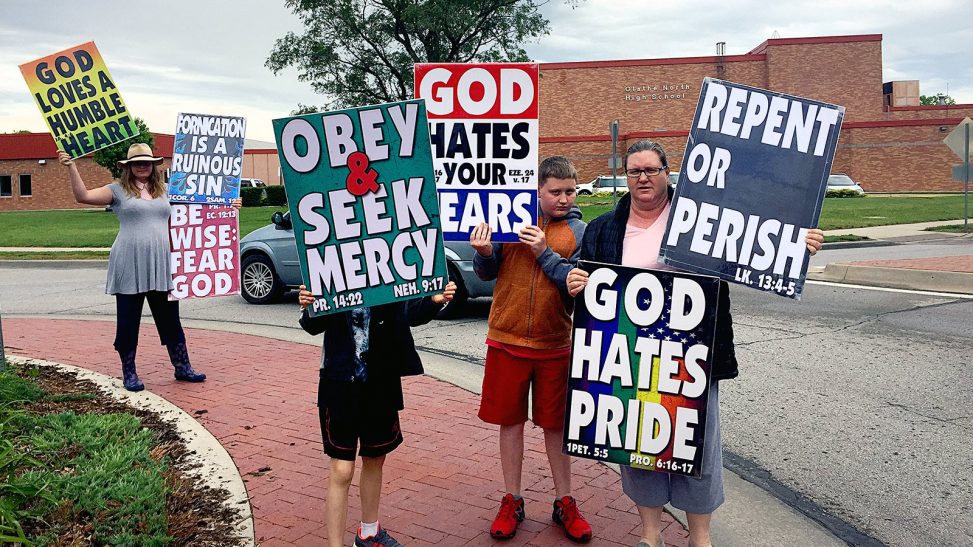
Above is a photo of members of the notorious Westboro Baptist Church protesting against homosexual individuals and reminding us of religion’s troubled relationship with homosexuality. Although not every religious individual is as overt as the picketers above, homosexuality is still an idea that causes anger and disapproval among many within the Christian community today. The anger that many individuals display towards homosexual individuals is puzzling, as Christianity also claims to be a religion rooted in love. It is also puzzling that homosexuality and other acts perceived as “sins” have the ability to spark such outrage within the religious community. This is even more baffling as the offended individuals do not seem to be directly affected by many of the choices that are considered “sinful”. In True to Our Feelings, Solomon says that when an individual loves, their conception of themselves is fused with their beloved’s (Solomon 60). In this paper, I will examine the puzzle of why love for God and for people within an individual’s own social group might fuel one to react in such violent and angry ways to actions that seem to have no direct interference with their own lives.
Many Christians are kind, accepting, and loving people. However, I also know the dark realities of religions that condition many people to believe that something is reprehensible without really giving a clear explanation why. Last summer, one of my best friends came out as a gay man in East Tennessee. I know that the decision to come out is very personal and difficult to navigate for many, but especially in our small, rural, church-centric town, my friend knew his identity was not going to be welcomed. He shared with me how he felt that people who loved him did not look at him the same way upon hearing the revelation, how his own mother cited religion as the reason what he was doing was wicked. This sparked the question for me, how can a seemingly non-harmful revelation about another person impact the love and respect that you have cultivated for them? How do people use religion to justify actions that are harmful to others?
Love makes the world go ‘round, but love can also make you do some crazy things. Love is generally seen as a “positive” emotion, but Solomon says that anyone who has ever been in love can attest to its nastier aspects (Solomon 52). When you love, your loved one’s identity becomes apart of you, “The self in love is an enlarged or expanded self that includes or embraces the other,” (Solomon 61). If this is true, then Solomon’s conception on love explains how an individual could hold anger against an individual, even though they themselves have not been wronged.
Within many sects of Christianity, it is a commonly held belief that the Bible says homosexuality is a sin. As one takes on the struggles and frustrations of their beloved, I believe that Christians partake in what they believe to be God’s anger. Solomon believes that love can cross the line into irrationality and self-destructiveness, and when it does we must depend on outsiders to check our perception and judgement (Solomon 56). This can be much more difficult when the outsiders around you hold similar views of God and the Bible. As many people believe that sin ruins the youth, perhaps their love for their own social group causes them to be angry at the possibility that they could be affected. In attempting to fulfill the greatest commandment, Christians are attempting to love God and become one with what they believe his character to be. In doing so, many end up breaking the second greatest commandment.
An opponent to this theory could argue that one’s own moral indignation is the cause of this anger, not love for any outside parties. Moral indignation is the kind of anger Christians feel when they become angry that an individual’s choices contradict the bible. According to Solomon, anger is basically a judgement that one has been wronged or offended and typically includes an accusation of blame (Solomon 18, 20). Solomon says that moral indignation is a strategy that repositions one as superior or righteous by accusing someone else based on some moral principle (Solomon 24). Therefore, it is possible that when Christians are angry at others for doing things they deem morally unfit, they are actually doing this to lift themselves up, not because they care about God’s view on the matter.
For Christians, the Bible is very important, as it reveals to them the identity and characteristics of God. As there are many instances of sin triggering God’s wrath in the Bible, then it follows that sin makes God angry. As God cannot sin, then his anger is always righteous. In the Christian religion, the highest commandment is to love. Matthew 26:36-39 says, “37 Love the Lord your God with all your heart and with all your soul and with all your mind. 38 This is the first and greatest commandment. 39 And the second is like it: Love your neighbor as yourself,” (BibleGateway). In layman’s terms, love God and love others, in that order. If individuals believe that being angry at people who sin against God is part of loving God, this would explain how some individuals are able to act completely different towards people they now see as sinners. If a Christian’s identity is rooted in what the Bible says, I think it is most possible that they are attempting to follow “the greatest commandment”, but are allowing themselves to interpret the Bible in a way that highlights the more judgemental aspects of God’s character. Subsequently, their identities are morphing with the identity that they have crafted for God.
As Solomon states that emotions are interactions with the world, I believe that the phenomenon of righteous indignation stems from the love that Christians feel for their God. This love causes them to take on the perceived injustices that God is facing and causes them to become angry at a situation that seemingly has no effect on them. I believe that the danger lies in attributing to God characteristics that have the possibility of being false. This does nothing but give people a confusing impression and distorted view of a God and religion hell-bent on loving the world. Solomon’s view on love and the way love causes one to expand themselves to include another is a plausible explanation for why normally loving individuals are able to act maliciously towards people who they feel have committed an injustice against their most beloved.
Works Cited:
“BibleGateway.” Matthew 22:36-40 NIV – – Bible Gateway, www.biblegateway.com/passage/?search=Matthew%2B22%3A36-40&version=NIV
Solomon, Robert C. True to Our Feelings What Our Emotions Are Really Telling Us. Oxford University Press, 2008.
Shared by: Lorraine Hayes