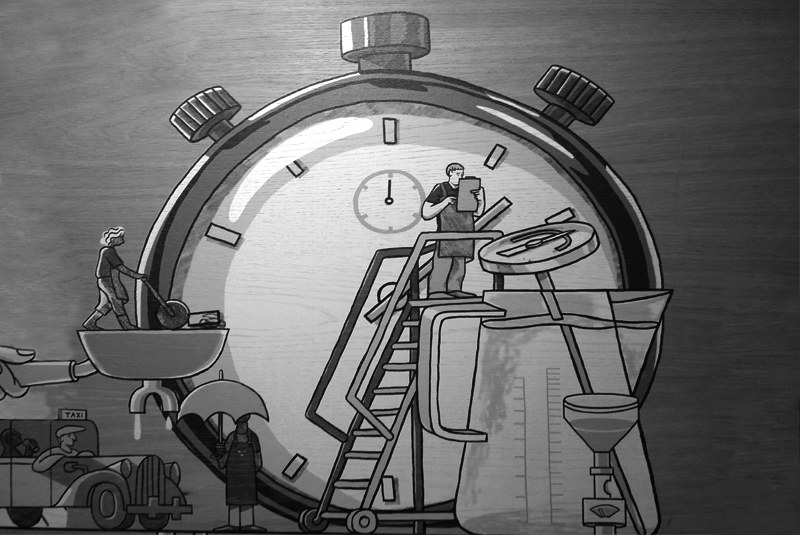
Imagine waking up to a new day. The sun is shining and birds chirping. You grab your speaker and play your favorite song to serenade you while you take a warm clean shower. A crisp red apple and a perfectly roasted cup of coffee provide a kickstart to your day. Out the door, you go. You catch every green light and when it comes time to pull into your parking spot, that groovy song from the stereo perfectly concludes. Sounds like a pretty ideal morning right? However, as you walk up to the front door of the office building, that careless and authentic smile slowly dissolves. The energy from your coffee and apple shifts your focus towards the stress of the work and the people you will have to deal with. What once seemed like an ideal and happy morning is now thrown out the window and forgotten. Why is this? How do you find real happiness in the drag of life?
To answer this question, it is worth exploring what happiness is. According to Robert Solomon, happiness is not a feeling that just comes and goes, but instead is an emotion that is “the sum of all our other emotions, the way they add up in our lives and the life they add up to” (Solomon, 266). I spent the past summer waiting tables. It was my job to deliver high-quality service, making my paycheck completely dependent on making other people happy. From the time I first greet the family or couple or table of one, to the time I cash out their check and wish them a great rest of their night, I was under constant review. If I messed up an order, brought out sweet tea instead of unsweetened, brought their food out to them a minute too late, or forgot to grab extra napkins for them, the more I messed up the more likely I was of receiving a poor tip. Now there are many things that could influence the way the customer thought of me; my energy, my smile, their day at work, or the occasion why they were there. The point is that my goal was to make their experience as “happy” as possible. I could have provided the “best” service ever, but if the customer is coming from a 3-hour long court hearing about the status of his divorce, what I do likely doesn’t matter. For him, when reflecting on his life at the present moment, happiness likely isn’t present. Solomon would argue that this man does not have high emotional integrity. For this customer, “obsessing on a single emotion [anger/sadness/resentment], blindly and without critical reflection” is “the virtual opposite of emotional integrity” (Solomon, 267).
Staying within the realm of the restaurant industry I spent three months of my life in, I was surrounded by numerous coworkers whose lives are a carbon copy of the scenario described at the beginning of this blog. I was always struck by these coworkers. For me, I knew there was a light at the end of the tunnel. My job had an expiration date in August. For many others, this was their career, or at least the stage of their lives before they move on to bigger and better things. For just about every shift I worked with this particular coworker, let’s name her Carly, I would ask her how she was doing. And every time, she would respond with some self-defeating comment; “Oh you know me, just trying to get to tomorrow!”, “Well, I’m here so clearly not feeling good.”, “Wish I was anywhere but here.”. I remember often wondering what motivated her. If she is that miserable about her job, mind you, she is in a managerial role for this restaurant, why would she come back to work every day? What gave her life meaningful purpose? Could she ever actually be happy? I would imagine Solomon would not think she could. Since happiness is an emotion bread out of an honest reflection of your life, I do not think Carly is ever truly happy. Certainly, her emotional integrity is lacking significantly.
For Carly, while her emotionality is quite negatively oriented, this does not mean she is hopeless. Solomon argues that there is an emotion that is even deeper than the “meta-emotion” of happiness, and that is spirituality. Spirituality, according to Solomon, is beyond the personal self in that it calls for us as humans to be mindful of our “more modest place in the universe” (Solomon, 268). Spirituality “transcends the self” which is what Carly may need. Perhaps she is embarrassed by her job, or perhaps she wishes she was doing something else as a career and that is why she shows up to work each day with a defeated mindset. Solomon would encourage her to take an even deeper mindset about her life, a mindset of gratitude. Solomon says “ingratitude reflects the inability to appreciate other people” as well as “the refusal to admit one’s debt to others” (Solomon, 269). The most important thing to be grateful for, according to Solomon, is our lives. I completely agree with Solomon in his stance on the importance of gratitude. Gratefulness can recenter our mindset about everyday tasks. It can provide us with a clearer sense of direction. If Carly could begin to spend a little bit of time each day to actively have a mindset of gratitude, perhaps her energy each time she walked into work would be different.
To conclude, while I agree with Solomon’s claim that happiness is a reflection of the life we are living or the life we have lived, there is more. The emotion of happiness goes deeper into mindfully reflecting on one’s place in the world. Happiness is grounded in spirituality, which in turn must be rooted in gratitude. I agree with Solomon in his claim about these emotions, but I think he is missing one piece of the puzzle. I find that there must be a sense of purpose. In accordance with Solomon, I believe that if one could wake each morning with a grateful attitude, with a mindset of humility knowing their modest place in the world, but feel a sense of purpose in their life, then true happiness can easily be achieved. Happiness in life is not just about passive gratefulness, but also an active and purposeful mindset. So, how do you find real happiness in the drag of life? I believe it is through a mindset of gratefulness accompanied by a true sense of purpose in one’s life.
Shared by: Anonymous
Image Credit: https://madrascourier.com/art-and-poetry/going-through-the-motions/