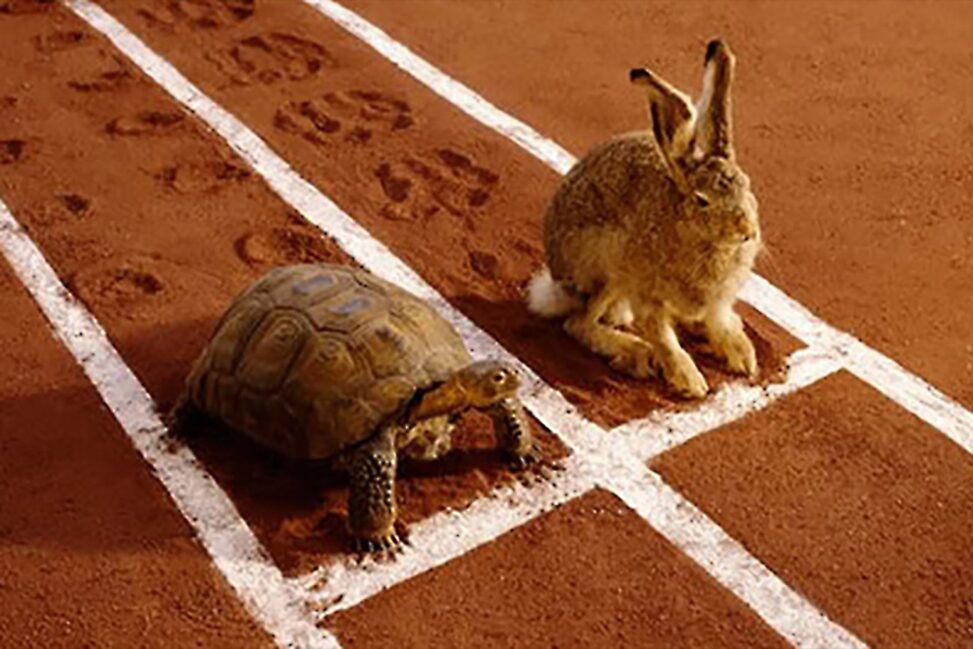
When I first started cross country, I would sprint at the sound of the start, quickly fizzling out before getting to the middle of the course. Throwing all of my energy into the beginning of the race meant that I had none left by the end; it’s fair to say that it didn’t take me long to learn how to pace myself. In other aspects of life, I found myself doing the same thing. I threw myself into tasks at a speed of 100 mph, never stopping to learn how to divide my energy. Learning how to pace yourself while running a race is much easier than in other aspects of life. In the story of the tortoise and the hare, I was the hare.
This was not an endurable way of living, though. After my short bursts of energy, I would experience burnout, causing me to develop anxiety. I constantly worried if what I was doing was enough, even though I put in more energy than required. And the cycle continued. A sustainable mindset/behavior produces a sustainable way of living.
Oftentimes, environmentalists experience burnout as well. Environmentalism is a race that does not have a finish line, and we will most likely be running it for the rest of our lives. When we get passionate, it’s easy to make sustainable swaps to our behaviors, and then we get into a rut again once we get distracted by something else. In her book, A Field Guide to Climate Anxiety, Sarah Jaquette Ray explains how we could resist burnout in a world that almost requires it. She says, “The planet seems to demand that we pay our debt to it by killing ourselves.” (Ray 129). We cannot experience pleasure without buying into the consumerist nightmare that our world has become. This, Ray explains, causes people to feel guilty and ashamed. She further explains that guilt is not a reliable tactic for inducing change, as we often want to get out of guilt rather than change the problem itself. Ray explains that this is because guilt is a self-interested emotion. Using negative, self-interested emotions to adapt behavioral tendencies is not viable. If this is the case, as Ray suggests, what is the necessary mindset to have to fight with endurance against climate change?
Instead of relying on negative emotions such as guilt in order to change behavior, Ray chooses to take on a mindful mindset when it comes to inanimate objects. At times, it is hard to visualize your purchases’ effect on the environment. Still, viewing the item as a product of labor and resources allows you to adopt a much more cognizant outlook. It forces you to realize that every single one of our choices is felt by people and nature in other places. None of our actions occur as an isolated event. Every action has its equal, opposite reaction. This healthy mindset eliminates guilt, as it permits a person to see gifts from the Earth as such.
Ray argues that we need “critical hope” as a motivator. Critical hope is “hope that gives people new resources to deal with the forces that affect their lives.” (Ray 123). We must imagine a way of life that is so incredible that we desire it wholeheartedly. People will continue to run back to the things that give them pleasure; thus, the most effective catalysts for change happen to be the desire for enjoyment or the better. “Desire is needed to sustain hope in the face of adversity” (Ray, 123).
Desire for a better future can be maintained simply by being more aware of the beauty around us. It’s necessary to slow down and smell the flowers and engage with nature to truly adore nature.
The argument could be made that negative emotions are necessary for this fight to carry on. As I’ve already noted, though, these negative emotions are proven to cause burnout and distract from the task at hand. It’s true; we must recognize our dire situation to comprehend the urgent need to fight. But acknowledging our alarming reality does not require us to feel remorse. As long as we care about the Earth, we will continue to advocate for a better world, so stepping back due to negative emotions would be in vain. Therefore, negative emotions are not viable motivators.
Even while viewing environmentalism with a positive mindset and a desire for a better future, rest is necessary. Ray emphasizes this by saying, “We must maintain our motivation to keep desiring the future, and keep working to create the conditions that will make that future not just tolerable, but worth living for.” (Ray, 126). Grounding techniques such as meditation are increasingly important. Just as the ocean takes a pause and draws back before the next wave comes crashing, we must also pause, recuperate, and ready ourselves for the next surge. If we get caught in an infinite loop of crashing waves, we will become weak and unable to fight.
The task of saving the world has been placed in our hands. Whether Gen Z likes it or not, this has to be our battle. The generations before us were entirely unreliable and ultimately failed. While the task forced into our hands is urgent (and incredibly daunting), we as a generation are capable. The good part is that we do not have to fight alone. As Ray says, “We are a collective- a choir of voices-we know that the song will continue while we are recovering our breath, and that we can rejoin when we can.” (Ray, 133).
Planet Earth is our only home, and every voice counts in this fight for a future. Although the generations before us have failed, that does not mean we will. We must run the race set before us with endurance. But with a changed mindset, we realize this race is a relay, and we can always pass the baton when a break is needed. Slow and steady wins the race.
“The race is not always to the swift.” -Aesop
Shared by: A.S.
Image Credit: https://www.entrepreneur.com/growing-a-business/why-slow-and-steady-wins-the-race/228458