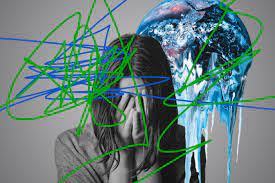
Climate Anxiety. Let’s talk about it. By now, I’d say we’re all familiar with what it is and how it’s affecting our society. But when we say “our society” who exactly are we talking about. I’ve grown up hearing about climate change in many different contexts whether it be political, social, in schools, with my family, but I’ve come to realize that while it is a big topic of controversy and discussion in America, it’s not as big a deal in South America, more specifically in Colombia. My question is why. Why are we as a society dealing with so many emotions in relation to climate change, when kids our age in other countries are not? And it’s not to say they don’t care about climate change, it’s more so their approach to the matter is a lot less emotionally charged and I would like to explore why that is. Is climate anxiety an actual thing? Or is it just something our generation is dealing with as a result of the way we’ve been taught about climate change. And before you bring up the case that there’s a bigger wealth gap in those countries and that maybe it’s only talked about amongst the wealthy and the educated, you would be surprised to find that it’s actually not the case.
Let me give you some context, growing up in Miami, I’ve always been hearing that in ten years, my home is going to be underwater and that it’s all my fault, and that by going to the grocery store and purchasing processed foods and plastics, I’m killing all the turtles. As a child, that’s a very frightening thing to hear. Mind you every summer when I go to Colombia, it’s almost as though the topic of climate change has disappeared. Fast forwards 10 years, I’m now a 16 year old in high school talking with my friends about climate change in a political context, my liberal friends telling my conservative friends that they are personally causing the downfall of our planet and my conservative friends responding by calling them “hippie libtards” (pardon the french). But again, come summer time, when I’m Colombia, talking with my cousins and friends about politics, climate change is never brought up. Which is also weird because at least the part of Colombia where I’m from, nature is a big part of life. Fast forward three years. I’m now a 19 years old in college taking a philosophy of emotions class where I’m hearing my classmates express genuine fear about the climate and seeing how it affects many of their decisions pertaining to their futures. What really piqued my interest though, was when reading A Field Guide to Climate Anxiety, I noticed I was exposed to a bunch of terms I never even heard of. On page 20, Ray says the following; “Individuals like me who work with people experiencing these symptoms can display additional secondary symptoms such as vicarious traumas, compassion fatigue, or apocalypse fatigue. But these feelings are not limited to people working on the frontlines of trauma…more and more people witness ‘climate-change-induced trauma of loved ones, communities, species’”. The reason I underlined these is because (not to expose myself) I’d never heard of them before. I have definitely experienced climate anxiety but not to that extent so when I read those terms and found out what they meant I thought to myself “is this for real?” I then proceeded to ask almost every one of my friends about these terms to find that most of them felt them or at least knew what they were and knew someone who experienced extreme climate anxiety. I then asked them why they felt this way and most responded with their own version of “ because at this rate we’re literally not going to have a planet because of humans.” I then asked all my friends and family that are in college in Colombia or went to high school there and most of them genuinely thought I was making those up. I then asked them if they even cared about climate change and they responded to me with “yes but i’m not like suicidal about it, I’m doing what I can”.
In A Field Guide to Climate Anxiety Ray talks about how people are being taught about climate change through guilt and anger and even says that “Environmental educators and sustainability leaders are partly responsible for the attempts of young people like Madi to erase themselves.”(Ray, 23) and “People are profoundly disturbed by climate change, and being told that it is the fault of our own moral failings is not only demoralizing but factually wrong. It does not help us muster the stamina to stay involved in environmental work for the long haul. Instead, it can lead to various forms of self erasure, or cause people to give up in despair, choosing short-term avoidance and apathy over long-term climate justice.”(Ray, 25). While this is definitely the case in America and many developed countries, it really isn’t in those still developing. Whether it be because they have other priorities, or they are socially more conservative, the truth of the matter is that in Colombia at least, climate change is not talked about in the same manner that it is talked about here. Ray tells us that the approach to climate change should be one through love and passion because “It takes a huge emotional toll to watch what you love vanish”(Ray, 32) and I think she’s right. I think the reason why climate anxiety is such a big thing in America is because we’re being guilted into thinking we personally are the cause of the downfall of our planet. This also makes me question the validity of climate anxiety. If our planet was in the same state that it’s currently in, but the climate generation had grown up hearing “let’s work together to fix this amazing planet of ours” would we still experience these large amounts of climate anxiety? Would we still be basing our life decisions on our fear of how we’re affecting the world? Maybe, maybe not, I guess that is something we’ll have to work towards and see.
Shared by: Anonymous