Let’s begin with a contemplative exercise. Take some time to reflect on a role model in your life who you consider virtuous. Perhaps, this person has taught you the importance of honesty and personal integrity. Maybe, he or she has exhibited qualities of selfless leadership and unwavering courage amidst hardship. Regardless of who this person is, he or she is someone you want to emulate in your own actions and behavior. Now imagine the following scenario: you get a phone call from a friend who informs you that your role model has been accused of sexual assault. What is your response? Do you accept the possibility that this person you thought was virtuous is actually a rapist, or do you immediately pass off the accusations as an unjust witch-hunt?
If you are perfectly honest with yourself, then you likely will assume the latter position. In her book Down Girl, Kate Manne attributes this line of thinking as evidence of a phenomenon she coins as himpathy – the tendency to discredit and dismiss the accusations against men. When we explore the logic of this phenomenon, we see that it is justified by a commonly used line of reasoning. Surely, our own role models would never commit such vicious actions – thus, the accusations must be incorrect. Manne insists that this logic is dangerous, so she suggests we observe the evidence before making an assessment of a person’s character. Although Manne’s solution is ostensibly straightforward, it raises a puzzle concerning our view of moral character — does himpathy spawn from a false belief in the existence of character itself, or do we simply overattribute virtues to people who are less than virtuous? In this blog, I will offer an account which both affirms the unjust existence of himpathy while simultaneously granting the possibility for virtuous moral exemplars who deserve our sympathy.
Before I explain Manne’s account of himpathy, we must first engage and understand the broader notion of character. According to character theory, a “good person” is someone who over time possesses virtues which compels him or her to act in a virtuous manner (Miller 9). If a person exhibits the virtue of honesty, then we would expect him to act honestly in every aspect of his life. However, his honesty does not only relate to past or present behavior – it is also a predictor of future actions (13). For example, if an honest person is given a test in a room without a proctor, we would expect him to not cheat with his notes. More generally, moral character theorists say that a “good person” is one who habitually develops modes of virtuous behavior that apply regardless of fluctuating situational variables. Conversely, a “bad person” is someone who would exhibit vices in similar situations and circumstances. This idea becomes crucial for our remaining discussion – by using virtuous or vicious descriptors, we are appealing to habituated patterns of behavior which predict future action.
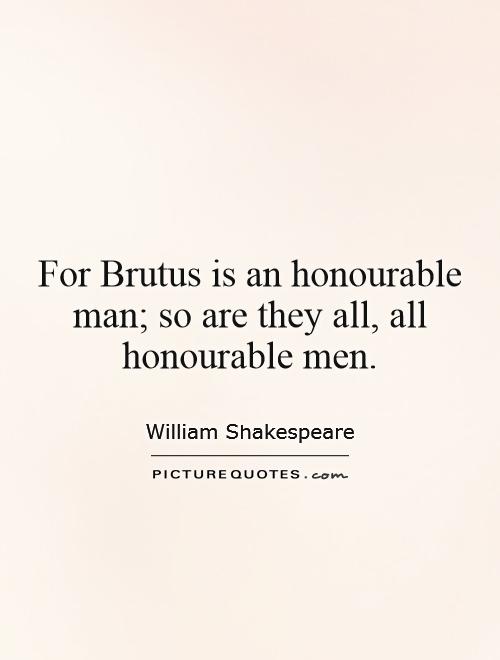
In her exploration of misogyny, Manne attributes this character and virtue language to patriarchal and bias patterns of epistemic trust given to men over women (Manne 198). When a male perpetrator harms a woman, we rarely doubt the man’s defense if there is evidence that he is a trustworthy and honorable person. Unfortunately, we almost universally see men as trustworthy and honorable, so the perpetrator’s defense always stands – Manne calls this the “honorable Brutus problem” (198). To observe this problem, we can lay out this logic in a straightforward modus ponens:
P1. If a man is trustworthy and honorable, then he would not commit such
a crime.
P2. This man is trustworthy and honorable
C. Therefore, he did not commit such a crime.
On first glance, this logic seems sound – a trustworthy and honorable person wouldn’t commit a crime. Unfortunately, the problem lies within premise two – if we attribute “honor” and “trust” to every man, then his defense will always withstand the counterevidence. If we return to our discussion of character, we can see how these virtuous attributes become problematic. A “trustworthy” and “honorable” character is one which predictably acts trustworthily and honorably across a wide variety of circumstances. If character theorists are correct, the crimes leveled against the honorable man would be “out of character.” Manne argues that this logic of himpathy is untouchable, so female accusers’ testimonies will almost always be doubted. Fortunately, Manne suggests a straightforward solution to this problem – we merely shift the modus ponens to a modus tollens:
P1. If a man is trustworthy and honorable, then he would not commit such
a crime.
P2. This man committed such a crime.
C. Therefore, he is not trustworthy and honorable.
Although this seems like a relatively straightforward solution, its implementation raises multiple difficulties. Indeed, we can ostensibly conceive of a scenario where the modus ponens ought to apply. For the sake of argument, suppose a defendant is actually trustworthy and honorable – indeed, his character gives legitimacy to his defense. As we stated before, deceit is antithetical to trust, so a person of trustworthy character would tell the truth. In this case, we ought to believe the testimony of the honorable person – we should stick to the logic of the modus ponens. However, in order to accept Manne’s argument, we must have reason to accept the modus tollens. Perhaps, we can deny character outright and appeal to a universal negative proposition:
P1. No person is reliably, consistently, and predictably honorable and
trustworthy.
P2. This man is a person.
C. Therefore, this man is not reliably, consistently, and predictably
honorable and trustworthy.
If we accept this proposition, then we have reason to accept Manne’s modus tollens argument. In this case, we start from the position that no one has consistent and reliable virtues in the way conceived by character theorists. Thus, we remove the starting assumption that the defendant is “trustworthy” or “honorable.” Since no man is presumed trustworthy or honorable from the outset, the female accuser’s testimony carries more power and weight. Unfortunately, there are significant costs to this explanation – we must outright deny the existence of moral character. To explore the lure of this particular solution, let us now turn to the situationists.
In his essay, “Out of Character: On the Psychology of Excuses in the Criminal Law,” John Doris uses recent empirical evidence from psychology to shed skepticism on the notion that we can have stable, reliable, and predictable characters. Doris argues that a long experimental tradition in social psychology proves that “situational influences often appear to do their work with little regard to the character of the person in the situation” (477). For example, experiments have shown that an overwhelming majority of test subjects would deliver a lethal shock to a bystander at the request of an authority figure (477). Additionally, subjects have been found five times more likely to help an injured bystander if the surrounding noise levels are quiet as opposed to noisy (477). In these experiments, small situation variables like sound, smell, and setting seem far more effective to predict behavior than an appeal to the subject’s character. Since this is the case, Doris recommends that we do not appeal to character in our judgement of wrong action – instead, we should view wrong action independently of the moral agent. This skepticism of moral character provides a compelling reason to accept the modus tollens in Manne’s argument. However, the situationist critique overlooks a crucial fact – despite fluctuating situational variables, a minority of test subjects did act virtuously in the experiments. In this way, the conception of moral character withstands the situationist objection. It appears that some people do act consistently and reliably virtuous across a variety of situations. In order to accept Manne’s argument, we must affirm the existence of moral character while acknowledging the existence, albeit rarity, of those who are actually virtuous.
In The Character Gap, Christian Miller uses the same empirical evidence of psychology to create a view sympathetic of both the moral character theorists and the situationists. Instead of outright denying the existence of character, Miller concludes that “most people have characters which are neither virtuous nor vicious. They instead fall in a middle space between virtue and vice” (156). As a result, our mixed characters explain why we act unpredictably across a wide range of circumstances – both virtuously when in the presence of positive role models and viciously when an authority figure commands us to perform evil actions. Although we frequently apply virtuous descriptors to people, Miller insists that “virtuous people are very much in the minority” (157). With this in mind, we have reason to accept Manne’s modus tollens:
P1. Very few people are reliably, consistently, and predictably honorable
and trustworthy
P2. This man is a person
C. This man is very likely not reliably, consistently, and predictably
honorable and trustworthy
Nevertheless, this argument affirms the existence of a virtuous minority who have earned the right to the modus ponens. However, unless such a person is within the ranks of Mother Teresa, Gandhi, or Jesus, we should probably withhold our exonerations and instead trust the evidence and victim testimonies. In this way, we can fight against the societal trend of himpathy while still maintaining models for virtue cultivation and habituation. This solution compels us all to develop virtuous characters and justly secure the benefit of the character defense offered by the modus ponens.
Shared by: Dylan Brown
Image Credit: http://www.picturequotes.com/for-brutus-is-an-honourable-man-so-are-they-all-all-honourable-men-quote-18777