Family Guy is undeniably one of the most thematically controversial, denounced and censored animated sitcoms currently broadcast on prime-time television. Critics have stated, “Like so many other people, I was just shocked by what I saw on Family Guy last night.” (Hammer, 2011); “[those remarks were] shockingly insensitive” (Hartinger, 2010); and “What I saw was seriously awful” (Jefferson, 2011). As is evidenced by the aforementioned quotes, Family Guy is perhaps most distinguished for its seemingly casual, unfiltered mockery of social taboos, including, but most certainty not limited to: gender, race, religion and sex. More specifically, Family Guy is particularly infamous for its objectification and mockery of women. Nevertheless, and despite Family Guy’s crude manipulation of genuinely serious, highly charged issues, the show remains greatly applauded. This critical acclaim, and the show’s subsequent tremendous popularity, has led to a sentiment of cognitive dissonance for some viewers, notably those who identify as women, as the subjugation of women for the furtherance and enhancement of a show’s comedic effect should not be permitted or endorsed by its audience, especially by those who are oppressed by said humor.
This discussion will focus on the overt ridicule of the female gender exclusively in the episode, The Simpsons Guy (Season 13, Episode 01): a forty-five-minute-long crossover episode between the characters of Family Guy and The Simpsons. In conjunction with the novel, Down Girl, by Kate Manne, and the ameliorative conception of misogyny described therein, it will be possible to effectively analyze whether Family Guy’s seemingly misogynistic script propagates misogynistic attitudes both in its animated universe and among its female audience.
In her book, Down Girl, Kate Manne states that misogyny may be conceived of in the following two ways: firstly, she describes the ‘naïve conception’ of misogyny as a property of individual agents (typically, although not necessarily, men) who are prone to feel hatred, hostility, or other similar emotions toward any and every woman, or at least women generally, simply because they are women (Manne, 32). While Manne states that the preceding naïve conception of misogyny is commonly-held, it is deeply flawed: this definition is silencing for its victims, as it threatens to deprive women of a suitable name for a potentially potent problem facing them (Manne, 44). It is for this reason, among others, that Manne argues for an understanding of misogyny in an ameliorative form, described as the system that operates within a patriarchal social order to police and enforce women’s subordination and to uphold male dominance (Manne, 33). More specifically, Manne states that misogyny is primarily a property of social systems of environments as a whole, in which women will tend to face hostility of various kinds because they are women in a man’s world, who are held to be failing to live up to patriarchal standards.
Furthermore, Manne states that the ameliorative conception of misogyny “[is] about exiling the ‘bad’ women and [is] compatible with rewarding the ‘good’ [women] and singling out other women to serve as warnings for those who are out of order” (Manne, 2018). This is precisely the policing effect of misogyny: when a woman threatens the order of male dominance, she is punished in a variety of ways, sometimes in the form of verbal ridicule, as is exemplified by Family Guy. This ridicule effectively establishes a power balance between mocker and mocked, with the former gaining control over the latter, and thereby consequently reestablishing male dominance, while simultaneously ostracizing the woman in violation of the gender hierarchy established by said patriarchal society.
Family Guy focuses on the Griffins, a highly dysfunctional, five-person family: Peter, the father; Lois, the mother; Meg, the eldest and only daughter; Chris, the eldest son and middle child; Stewie, an infant who is wildly intelligent; and their anthropomorphic dog, Brian. Peter Griffin, the arguable protagonist, embodies the role of the ‘family guy’; he is responsible for “positively [doing] all the things that make us laugh and cry.” For those who are not regular viewers of Family Guy, it is worth mentioning that the preceding quotation is a lyric from the show’s opening credits. This lyric suggests that, before the substantive content of the episode is even broadcast, the title, and the show’s title sequence, inform the audience of the patriarchal environment within which the show takes place. This male-dominated universe is a potent breeding ground for the misogynistic behavior Manne describes.
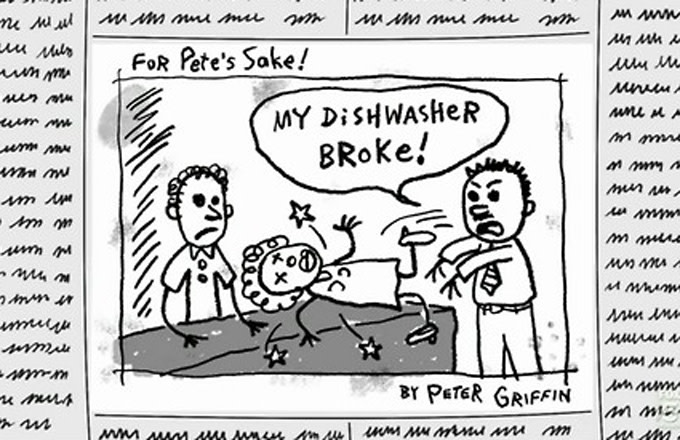
Furthermore, the title sequence also mentions the apparent absence of “good old-fashioned values, on which we used to rely”, further emphasizing the show’s blatant attempt at resurging and instilling within its audience the historic model of male masculinity, in conjunction with the classical family model, composed of a subservient wife and children who exist solely to tend to and to please their hard-working, unfeeling, aggressive patriarch. Perhaps this analysis is questionable, as Peter Griffin does not truly possess any of the aforementioned characteristics; however, he is undoubtedly the unforgiving orchestrator of the family, as he does whatever he pleases with little to no regard for the physical and emotional well-being of his wife and children. For example, in The Simpsons Guy, Peter publishes a series of offensive cartoons in a comic strip, entitled ‘For Pete’s Sake’, that outrage the online community, forcing the Griffins to flee their hometown of Quahog; the title alone already indicating the scandalous nature of the comic strip.
Peter says that he chose the aforementioned title because the comic, “points out things that make you shake your head and say, ‘for Pete’s sake!” (Season 13, Episode 01). For example, one such drawing shows a man throwing a woman down on a counter while yelling at a cashier, “My dishwasher broke!”. Peter furthermore states that he got published so quickly because, “the editor of the paper owed [him] a favor.” (ibid.) – Peter was able to get the editor a coveted photo of Spiderman. In said photo, Spiderman is seen in the very distant background, leering at a woman featured in the foreground, bending over a salad bar with her thong sticking out of her jeans. Peter states: “Yeah, I got a whole subreddit of superhero thong shots.” (Season 13, Episode 01). The implication is that the way in which Peter obtained his comic was through the objectification of a woman’s body: had he not taken the photo of a woman’s thong (thereby objectifying her as a sexual object of desire), he would not have captured Spiderman in the background, and therefore, would not have had a comic strip. Moreover, Peter’s friends also endorse, and even exaggerate, the repulsive essence of his comic strip. Quagmire suggests, “how about you draw a sock, and it says, ‘Sock it to me,’ or maybe draw Lois taking a hot-tub dump, and she just says whatever?” (Season 13, Episode 01). This example reinforces the idea that men are praised for sexualizing women, and the hostile degradation of women as a means to male achievement and success is a condoned practice of Family Guy’s society.
There is an important distinction to be made at this juncture: the characteristically oppressive humor in Family Guy conforms more seamlessly to Manne’s definition of sexism than it does to her definition of misogyny. While sexism and misogyny are closely linked, in that sexism has the overall function of rationalizing and justifying patriarchal social relations (Manne, 79), they are entirely independent concepts. Sexism, according to Manne, often works by naturalizing sex differences… and discriminating between men and women… sometimes counter to our best current scientific evidence (Manne, 79), whereas misogyny polices and enforces the governing norms and expectations of patriarchal order. A rather paradigmatic example of the aforementioned definition of sexism is when, in a featured cutaway, Peter and Chris walk into a store that is being guarded by a female security guard, where, upon seeing the gender of the security guard, Peter remarks, “Oh, good! We can steal.” (Season 13, Episode 01); evidently, Peter is hinting at the defunct notion that all men are physically superior to all women.
In The Simpsons Guy, and in the vast majority of, if not all, other episodes, the taunting of women is achieved primarily through verbal jest. These gags may occasionally be accompanied by visual aids that emphasize the utterance, as is the case with the above security guard example, or these gags may simply victimize women solely by virtue of their imagery, as does Peter’s comic strip. Despite the variation in comedic delivery, Family Guy centers the majority of its jokes around the female body, as would be expected. In doing so, the show taunts, embarrasses and shames the female viewer. Its parody degrades a woman’s body to sexual object, object of utility, or conversely, to undesirable object. For example, in The Simpsons Guy, Peter goes on a talk-show named “The Flow” – an obvious illusion to the ‘hilarity’ of a woman’s menstrual cycle. Interestingly, while on “The Flow”, the female host confronts Peter, stating: “You have no idea how offensive you are to women, do you?”, to which Peter replies: “What? I love women. I bet I can name more porn stars than you, but don’t tell my wife how many porn stars I know. I’ll get in a lot of trouble. I know all of them though.” (Season 13, Episode 01).
Additionally, the male characters demonstrate an abhorrent ignorance of female emotion, as is exemplified by the preceding quote, and a rather blatant unawareness of female bodily processes, such as the menstrual cycle. This incomprehension furthermore demonstrates a lack of interest, concern and respect for the female gender. The male characters also focus specifically and intensely on physical female characteristics that are unique to women, such as breasts or the female genitalia. For example, Peter states, with reference to his teenage son’s hunger: “Lois, whip out your boob and give the boy his lunch.”, to which Chris replies, “Listen to the man.”, followed by Brian stating, “Yeah, Lois. Listen to the man.” (Season 13, Episode 01). Strikingly, this demonstrates the extent to which Peter and the other male members of the family, expect women, Lois in particular, to cater to man’s every desire. This is just one example of several hundreds of offensive jeers Family Guy has said about women, all while nevertheless successfully managing to entertain and captivate its female audience.
As is illustrated by Family Guy, humor at the expense of a female victim, or any victim for that matter, not only incites a group to partake in the victim’s suppression through reinforcing commentary or collective laughter, but also stifles and diminishes any attempted defensive response given by the victim. This reactive muzzling occurs multiple times in The Simpsons Guy, particularly with respect to Lois, Peter’s wife. For example, the aforementioned quote regarding Lois breastfeeding her son, Chris, does not spur any sort of reaction from her, despite both Chris and Brian affirming Peter’s inappropriate comment. Lois instead dismisses the comment and simply states, “How about we just go to that store there?” (Season 13, Episode 01).
While various aforementioned examples have confirmed the misogynistic and sexist nature of Family Guy parole, the conclusion is the following: female viewers of the show are endorsing the patriarchy through their fandom and are thus not disrupting the male-dominated gender hierarchy of society. As a result, it may be speculated that female Family Guy fans are actually more likely to face hostility from other females who do not condone the show’s humor. It is possible that the latter group of women perceive the former’s fandom as a sort of understated acquiescence to the patriarchy, and thus are apt to express their dislike for those who are implicitly enforcing their subjugation in various forms, including, but not limited to, ostracizing the victim and impolite verbal commentary.
Shared by: Anonymous